Google Maps will not route you
Inside South Korea it cannot give walking, driving or transit directions. Almost every visitor finds this out standing on a pavement. This book links every place straight into Naver Map, which does work.
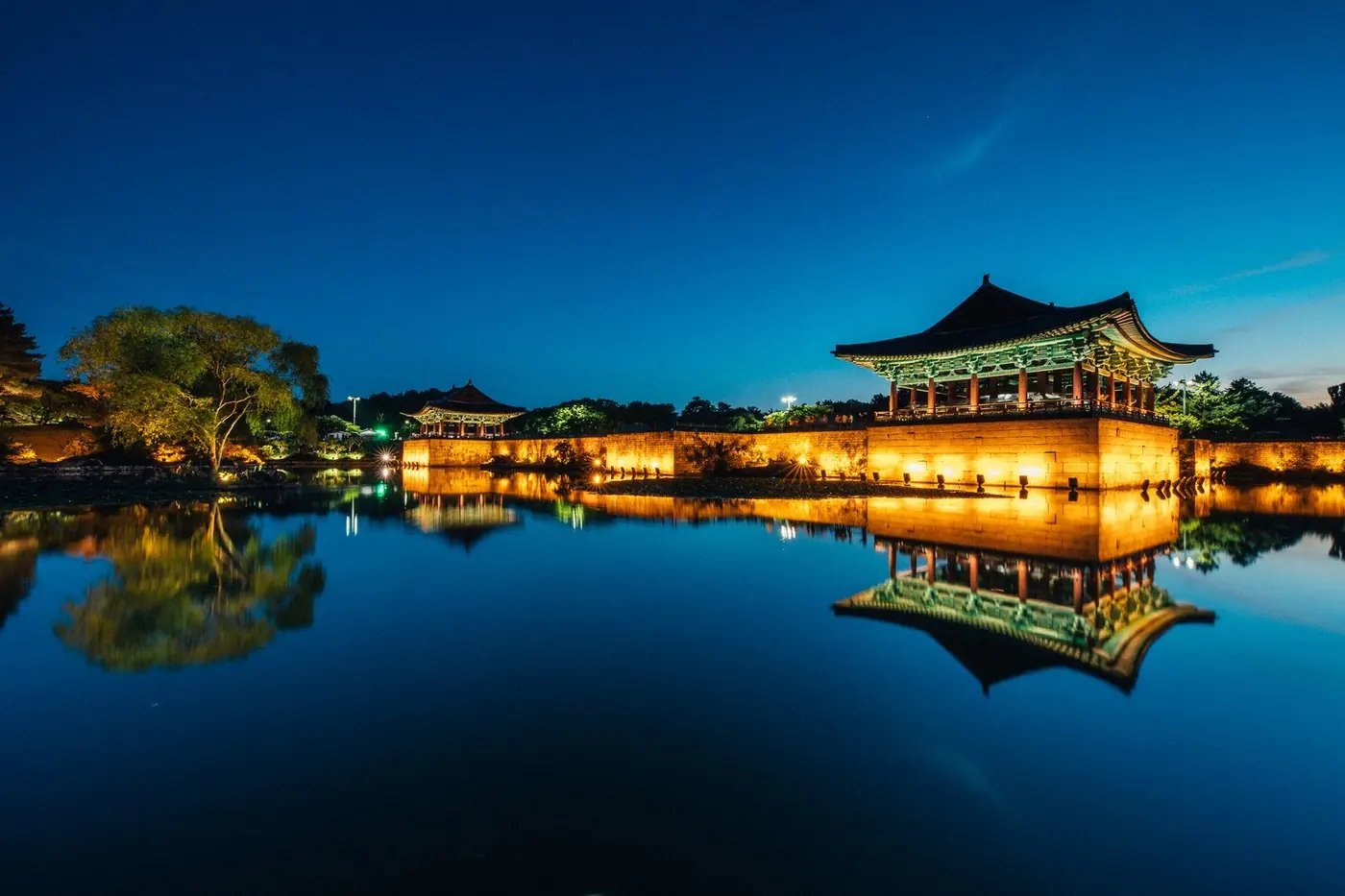
A day in Gyeongju planned to the clock, with every place written in Korean too, so you can show it to a driver or paste it into an app that works here.
It is everything between them.
Inside South Korea it cannot give walking, driving or transit directions. Almost every visitor finds this out standing on a pavement. This book links every place straight into Naver Map, which does work.
Say “Cheomseongdae Observatory” and you may get a blank look. Every entry here prints 첨성대 beside it. Hold up the screen and the conversation is over.
Monday closures, lunar-holiday closures, a museum that stops admitting at 17:30. There is a table at the front: pick your date first, and the closed places are already filtered out.
Seven things this book lets you do that a search result does not.
Each place carries its Korean name in type large enough to read across a counter. There are also two pages of phrases in Korean, with the sound written out, for asking a price, asking for no meat broth, or asking someone to speak slowly.
Not a list of names. Each route says when you arrive, how long you stay, and how many minutes to the next place, worked out from real coordinates rather than guessed.
Every place in the book is a live link into the map app Koreans actually use. The map that comes with the book is surveyed, not drawn, and the number on each pin is the page number.
That your card may not work in an ATM even when the screen says English. That there is no tipping, anywhere. That a Korean soup is usually built on anchovy stock. That the travel hotline 1330 will interpret for you, free, at any hour.
The food pages name Korean dishes, so a page before them explains each one in plain words: what it is, whether it is spicy, whether the broth is anchovy or beef, and whether it is built for one person or two. Sundubu looks vegetarian and is not.
A January day peaks around 5.9°C; an August one around 31.4°C, with nights near 22°C. In winter the sun is gone by 17:30. And because this city is walked, not driven, your shoes decide the day.
Korea runs 220V on the round European plug. British, US, Japanese and Australian plugs will not fit. Tap water is safe. Toilets are free and everywhere. And visa-waiver nationals are exempt from K-ETA until the end of 2026.
So here is the difference, put plainly.
And when a price changes, tell us: we correct it in the online viewer. That promise is printed on the last page.
Sources · CNBC, March 2026 · Korea Fair Trade Commission guidance, 2026
No. It is a PDF, 55 pages, sized for a phone. Download it once and it works offline, apart from the map links.
No. Every place is written in both languages, and there is a page of phrases in Korean with the pronunciation written out. Most of the time you will show the screen rather than say anything.
No. The old centre is walkable end to end. Bulguksa and Seokguram sit outside town, and the book says how to reach them and how long it takes.
Tell us at gildam.co.kr and we correct it in the online viewer. The date each fact was checked is printed in the book, so you can always see how fresh it is.
It is the old Silla capital, a thousand years of it, in a town small enough to walk. If you have one day outside Seoul or Busan, this is the one we would spend it on.
Guidebook, surveyed map and the free course calculator, all in one download.
Buy on Etsy · $9.90